Headless Product Configurator
Keep your frontend. Run configuration as infrastructure.
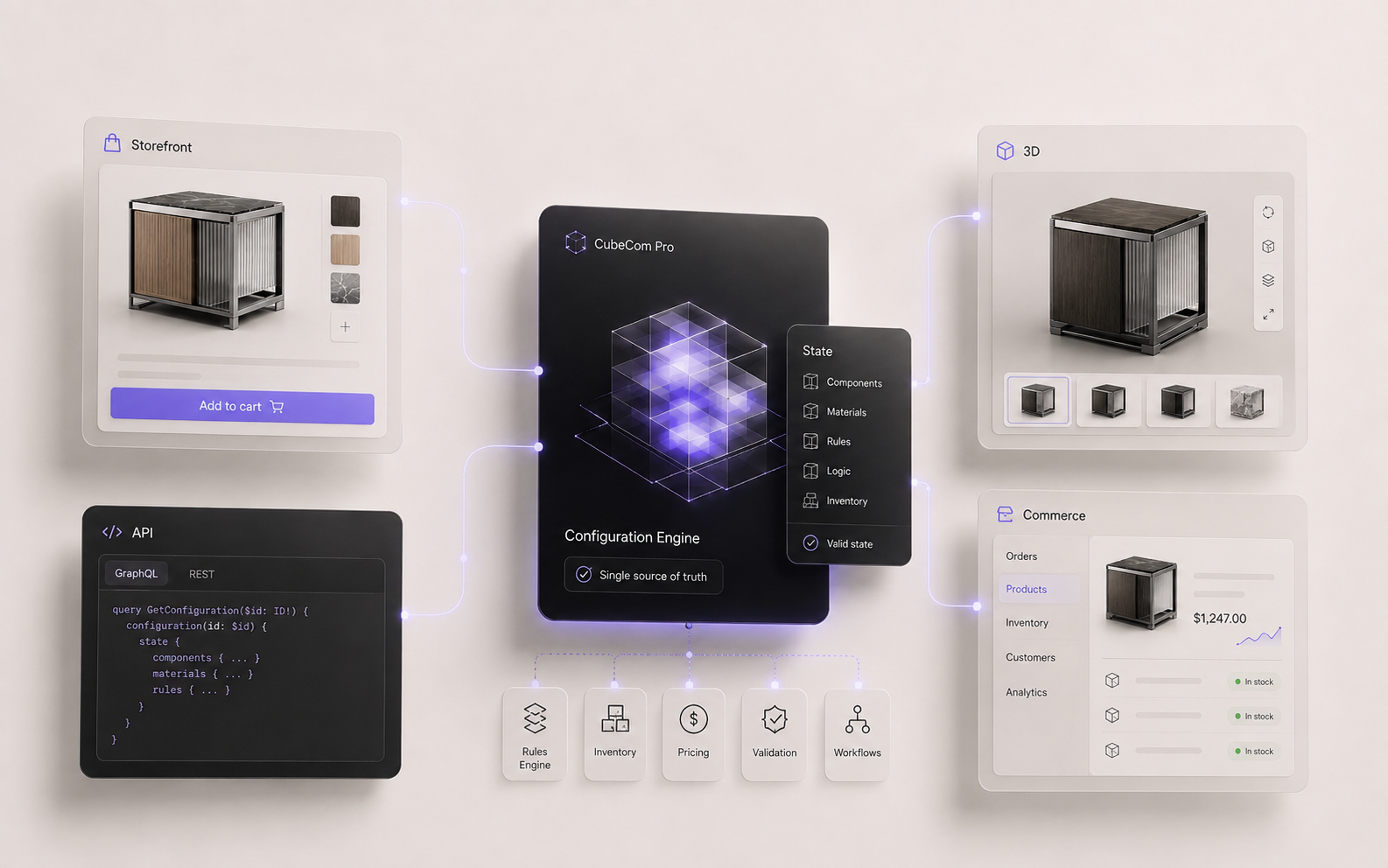
You own presentation and customer experience. CubeCom owns configuration truth — product graph, constraints, and deterministic commerce resolve.
Architectural Tension
Headless commerce still needs a source of configuration truth.
Composable stacks separate UI, CMS, checkout, and ERP. Without a dedicated configuration runtime, product logic ends up hardcoded across multiple frontends.
Hardcoded Frontends
Without CubeCom
Rules copied directly into React components drift over time. Merchandising updates require frontend deployments, and mobile or sales tools enforce different logic than the web.
Headless Runtime
With CubeCom
One centralized graph powers every surface. Frontends stay light, querying the runtime to validate choices and resolve deterministic line items.
System Architecture
Frontend presentation decoupled from configuration logic.
A lightweight runtime sits between your composable storefront and your commerce platform.
Runtime Architecture
One configuration runtime between experience and commerce.
Frontend → CubeCom Runtime → Valid State → Commerce Projection.
01
Custom Frontend
Your React, Next.js, or Vue UI captures shopper option selections.
02
CubeCom Runtime
Evaluates constraint graph, blocks invalid combinations, and resolves valid state.
03
Commerce Projection
Projects deterministic SKU, calculated price, and inventory directly to cart or OMS.
Headless Capabilities
Engineered for modern composable architecture.
Connect any frontend framework to a high-performance configuration runtime.
01
PRESENTATION FREEDOM
Complete UI ownership
Build custom configurator components in your design system without third-party iframe or plugin constraints.
02
CENTRAL GOVERNANCE
Single rules authority
Product dependencies and exclusions live in one engine, preventing rule drift across multiple storefronts.
03
STATE RESOLUTION
Runtime constraint evaluation
Validate complex multi-dimensional choices on the fly, guaranteeing every selection resolves to a legal state.
04
OMNICHANNEL TRUTH
Multi-surface consistency
Share the identical configuration logic across web storefronts, in-store sales associate tools, and mobile apps.
Deterministic Handoff Proof
See the runtime state pipeline in action.
How customer intent translates from a custom Next.js storefront to verified line items in Shopify checkout.
STATE PIPELINE
Selection → Validate → Resolve → Commerce → Cart
Selection
- fabric
- beige
- size
- 3-seat
- legs
- brass
Validate
- valid
- true
- violations
- []
Resolve
- sku
- SOFA-3S-BEI-BRS
- price
- 2399
- inventory
- 4
Commerce
- variant
- SOFA-3S-BEI-BRS
- line
- ready
- qty
- 1
Cart
- cart
- open
- checkout
- next
- order
- pending
Selection
- fabric
- beige
- size
- 3-seat
- legs
- brass
Validate
- valid
- true
- violations
- []
Resolve
- sku
- SOFA-3S-BEI-BRS
- price
- 2399
- inventory
- 4
Commerce
- variant
- SOFA-3S-BEI-BRS
- line
- ready
- qty
- 1
Cart
- cart
- open
- checkout
- next
- order
- pending
Storefront
CubeCom
Commerce
Engineering & Merchandising Outcomes
The benefits of headless configuration infrastructure.
Empower engineering agility while giving merchandising teams full control.
INTEGRATION AGILITY
Faster integration through a shared contract
Frontend developers query simple, structured endpoints instead of reimplementing hundreds of custom validation rules.
ZERO CODE DRIFT
Eliminate duplicated frontend logic
When manufacturing rules or option dependencies change in CubeCom, every frontend updates immediately without code deployments.
CLEAN ARCHITECTURE
Clear separation of concerns
Frontend teams focus on customer experience; merchandising teams control catalog logic and commerce mappings.
Need to interact with this runtime directly over GraphQL or REST? See the Product Configuration API.
Product Configuration APIHeadless configurator FAQ
Still mapping your catalog, rules, or commerce path? Bring one product and we’ll show where CubeCom should sit.
Book a solution sessionIs CubeCom a headless CMS?
No. It is configuration infrastructure for sellable product state — not a content CMS or full ecommerce platform.
Can we use Next.js or a custom storefront?
Yes. You own the frontend and design system. Call resolve from your app while checkout stays on your commerce platform.
Who owns configuration rules in a headless stack?
CubeCom owns configuration truth — the product graph, constraints, and resolve. Your storefronts, sales tools, and agents consume the same sellable state instead of re-implementing rules per channel.
How does this relate to composable commerce?
CubeCom is the configuration capability in a composable stack — beside PIM, commerce engine, and storefront — not a replacement for those systems.
Walk your architecture with CubeCom.
Storefront, PIM, cart, and where configuration should sit — mapped in one session.