Product Configurator
Rules first. Variants last.
Model product options, dependencies, and exclusions once. Resolve every valid configuration to SKU, price, inventory, and cart. Configuration logic and commerce resolution — 3D is optional.

Variant matrices explode. Rules do not.
Options → Constraints → Valid State → SKU / Price / Inventory. That is the engine path — whether or not a 3D scene is attached.
Traditional model
10 × 8 × 6 × 5 = 2,400 variants
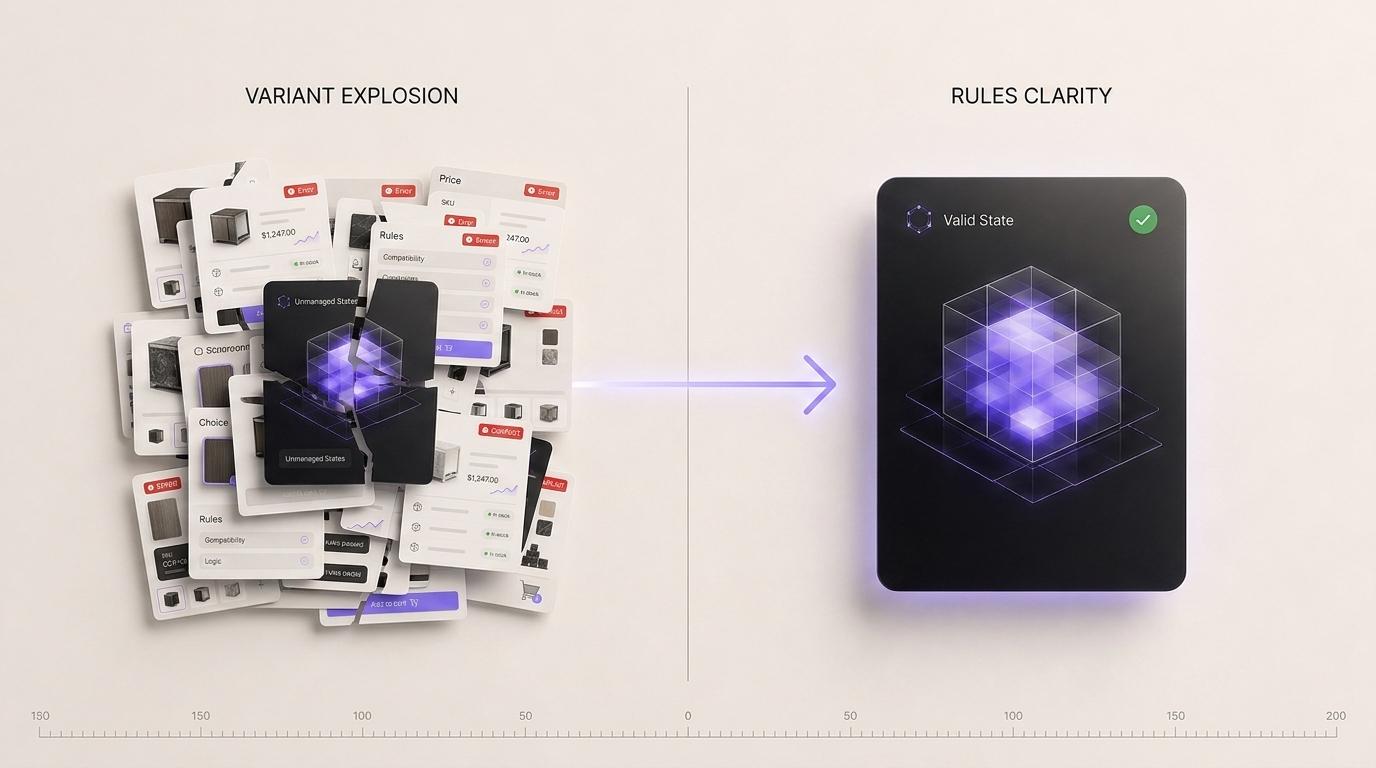
Variant matrix explodes into thousands of disconnected fragments — rules resolve into a single valid state.
CubeCom model
4 dimensions + 12 rules → runtime resolve
- ↓
- ↓
- ↓
Step 1 of 4
System Architecture
Configuration logic separated from storefront presentation.
A singular rules engine evaluates constraints before resolving to SKU, price, and inventory.

Core Transformation
Every choice has a consequence. CubeCom resolves it.
Product Graph → Valid State Resolution → Commerce Projection.
01
Product Graph
Options, dimensions, dependencies, and exclusions describe the full configurable product family.
02
Valid State Resolution
CubeCom evaluates every choice against the rules graph and resolves one legal product state.
03
Commerce Projection
The resolved state deterministically projects to SKU, price, inventory, and the exact cart line.
Engine Capabilities
Stop managing combinations. Start modeling the product.
Define dependencies, exclusions, and availability once. CubeCom resolves the legal sellable state at runtime.
01
DEPENDENCIES
Option dependencies
Choosing one value changes what else is legal — dimensions constrain fabrics, finishes constrain hardware.
02
EXCLUSIONS
Exclusion rules
Hard blocks for combinations you will never manufacture or stock, without deleting options from the master family.
03
AVAILABILITY
Conditional availability
Options appear, hide, or rewrite dynamically at runtime based on the shopper’s current selections.
04
FAMILIES
Product-family modeling
One graph for a full product line: shared attributes, per-SKU commerce references, and central rules governance.
Interactive Proof
Test the live option graph.
Try selecting Brass legs with Charcoal fabric below — the engine automatically catches the exclusion and rewrites to a valid configuration.
Live option graph
Try Brass → Charcoal is blocked
Fabric
Size
Legs
Resolution
SKU
SF-3-BEI-BRS
Price
$2,479
Inventory
4
Valid
Yes
Business Outcomes
What improves with configuration infrastructure.
Move from brittle variant management to reliable runtime resolution.
PREVENT ERRORS
Prevent invalid configurations before cart
Impossible product combinations are rejected or rewritten in real time, preventing unfulfillable custom orders from reaching checkout.
CATALOG EFFICIENCY
Eliminate static variant bloat
Stop pre-generating thousands of static SKU variations in your commerce platform. Define dimensions and resolve sellable states on demand.
COMMERCE TRUTH
Instant price and inventory projection
Every valid selection map deterministically projects to the exact line item SKU, dynamic pricing tier, and inventory status.
Need the configuration to be visual? See the 3D Product Configurator.
3D Product ConfiguratorProduct configurator FAQ
For teams modeling catalog complexity — dependencies, exclusions, and sellable state — with or without 3D.
Book a solution sessionDo I need 3D to use a CubeCom product configurator?
No. This page is about configuration logic and commerce resolution. 3D is optional — the same engine powers 2D UIs, APIs, and the 3D Product Configurator when you need a visual surface.
How is this different from Shopify options or variant matrices?
Variant matrices explode and still miss cross-option constraints. CubeCom encodes dependencies and exclusions, resolves a valid state at runtime, then projects SKU, price, and inventory — without publishing every combination.
What kinds of rules can we model?
Option dependencies, exclusion rules, conditional availability, and product-family constraints — so illegal combinations never become sellable states.
What is commerce resolution?
Mapping a valid configuration to SKU, price, inventory, and cart-ready identity so every legal state is sellable across channels.
When should I look at the 3D Product Configurator?
When shoppers need to change materials, parts, or geometry visually. The 3D page is the buying experience; this page is the engine underneath.
Bring the product family you’ve outgrown.
We’ll map the options, constraints, and commerce resolution together.